5 Critical Mistakes Startups Make When Buying Test Equipment (And How to Avoid Them)
The path from prototype to product is littered with the remains of promising startups that made critical missteps in their equipment procurement strategy. According to recent industry analysis, nearly 40% of hardware startups that fail cite inadequate or poorly planned testing infrastructure as a contributing factor to their demise. While founders obsess over product features and market fit, many overlook the foundational importance of smart test equipment decisions.
The stakes couldn’t be higher. In today’s competitive hardware landscape, the difference between a startup that scales successfully and one that burns through funding lies often in the details—particularly in how they approach the essential but expensive world of test and measurement equipment. The following five mistakes represent the most common and costly errors that can derail even the most promising ventures.
Mistake #1: Buying Instead of Evaluating Rental Options First
The startup mentality often defaults to ownership. Founders see equipment as assets to be acquired rather than capabilities to be accessed. This mindset can prove financially devastating when applied to test equipment, where individual instruments can cost $50,000 to $200,000 or more.
Consider the case of a Bay Area IoT startup that allocated $300,000 of their Series A funding to purchase a comprehensive test setup for their wireless sensor development. Within eighteen months, they discovered their initial testing requirements had evolved significantly, rendering half their equipment inadequate for their current needs. Worse, when they needed to pivot their technology stack, the specialized equipment they’d purchased became entirely unsuitable for their new direction.
The financial impact extended beyond the initial purchase. The equipment required climate-controlled storage, regular calibration, and specialized technician training—costs that hadn’t been factored into their original budget. By month twenty, they’d spent an additional $80,000 in associated expenses while their equipment utilization rate hovered around 15%.
Companies like GS Testequipment Inc in Irvine, California have seen increasing demand from startups seeking flexible equipment rental solutions that preserve cash flow during critical growth phases. The rental approach allows startups to access enterprise-grade equipment without the massive capital outlay, while maintaining the flexibility to adapt their testing strategy as their product evolves.
The key insight here is that startups operate in a fundamentally different context than established corporations. Where a mature company might benefit from equipment ownership over a predictable, multi-year product lifecycle, startups face constant iteration, pivoting, and scaling challenges that make flexibility more valuable than ownership.
Smart startups recognize that preserved capital can be deployed in core business activities that typically generate higher returns than avoiding equipment depreciation. The opportunity cost of tying up hundreds of thousands of dollars in test equipment often exceeds any potential savings from ownership, particularly when considering the risks of obsolescence and changing requirements.
Mistake #2: Underestimating Oscilloscope Requirements
The oscilloscope represents the cornerstone of most electronic testing setups, yet it’s where many startups make their most consequential specification errors. The temptation to save money with an entry-level scope often results in expensive delays and compromised product quality down the line.
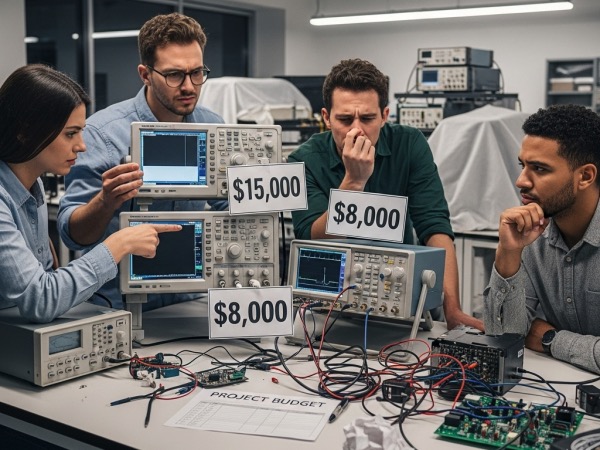
A medical device startup recently discovered this reality when their $8,000 oscilloscope proved inadequate for analyzing the high-frequency switching characteristics of their power management system. The scope’s limited bandwidth and sample rate meant they couldn’t properly characterize signal integrity issues that were causing intermittent device failures. The resulting product recalls and regulatory delays cost the company over $2 million and nearly ended their business.
The challenge lies in anticipating future needs during the early stages when requirements seem straightforward. Initial prototypes often operate at lower frequencies and with simpler architectures than production designs. As products mature, they typically require higher performance, more complex signal analysis, and deeper debugging capabilities that entry-level equipment simply cannot provide.
For startups unsure about specifications, renting different oscilloscope models allows testing various options before committing to a purchase. This approach enables teams to experience firsthand how bandwidth, sample rate, and analysis features impact their specific applications.
The specification trap extends beyond basic performance parameters. Modern oscilloscopes offer advanced triggering, protocol analysis, and signal integrity tools that can dramatically reduce debugging time. A startup that skimps on these capabilities may find their engineering team spending weeks troubleshooting issues that could be resolved in hours with the right equipment.
Memory depth represents another frequently overlooked specification that can severely impact debugging effectiveness. Inadequate memory depth prevents capture of long-duration events or detailed analysis of intermittent problems. When debugging complex issues, the ability to capture and analyze extended signal sequences often proves essential for identifying root causes.
Mistake #3: Ignoring Power Management Testing Complexity
Power consumption has become a critical differentiator in nearly every electronic product category, yet many startups underestimate the sophisticated testing required to optimize power performance. This oversight typically manifests in two ways: inadequate power supply equipment and insufficient current measurement capabilities.
Battery-powered devices, in particular, require precise current profiling across multiple operating modes, sleep states, and load conditions. A fitness tracker startup learned this lesson expensively when their product launched with battery life significantly shorter than advertised. Their basic benchtop power supply couldn’t provide the low-noise, high-resolution current measurements needed to identify power inefficiencies in their wireless communication protocols.
The testing requirements for power management extend beyond simple voltage and current measurements. Modern products require analysis of power quality, efficiency curves, transient response, and thermal characteristics under various operating conditions. This demands sophisticated power supplies with programmable output capabilities, electronic loads for dynamic testing, and high-precision measurement instruments.
Many startups discover too late that their power optimization efforts are hampered by measurement uncertainty. When you’re trying to extend battery life from 8 hours to 12 hours, measurement accuracy becomes critical. The difference between a $5,000 power supply and a $20,000 precision unit isn’t just features—it’s the measurement confidence needed to make design decisions that directly impact product performance.
Load regulation and transient response testing require capabilities that basic power supplies cannot provide. Advanced power supplies offer features like voltage slewing control, current limiting precision, and fast transient response that enable comprehensive power management characterization. These capabilities often prove essential for optimizing power delivery systems and ensuring stable operation under varying load conditions.
Mistake #4: Overlooking Signal Integrity Analysis
As product designs push higher data rates and smaller form factors, signal integrity issues become increasingly problematic. Startups often dismiss signal integrity analysis as a concern for high-end applications, only to encounter mysterious performance issues as their products scale to production volumes.
The symptoms typically emerge as intermittent communication failures, reduced wireless range, or degraded sensor performance that can’t be reproduced consistently. These issues often stem from crosstalk, impedance discontinuities, power supply noise, or electromagnetic interference that wasn’t properly characterized during development.
A robotics startup experienced this firsthand when their control system suffered from intermittent servo motor glitches that only appeared in certain environmental conditions. Traditional debugging approaches failed to identify the root cause until advanced signal analysis revealed power supply ripple that interacted with their motor control PWM signals. The solution required both hardware redesign and months of additional testing that could have been avoided with proper signal integrity analysis from the start.
The challenge for startups is that signal integrity problems often don’t manifest until the design is stressed by production variations, temperature extremes, or electromagnetic environments that differ from the benign lab conditions where initial testing occurred. By the time these issues surface, fixing them requires expensive redesigns and potentially costly product recalls.
Eye diagram analysis, jitter measurement, and crosstalk characterization require specialized equipment and expertise that many startups lack. However, these measurements become increasingly critical as data rates increase and noise margins decrease. The cost of inadequate signal integrity analysis often far exceeds the investment required for proper characterization equipment.
Mistake #5: Neglecting Calibration and Maintenance Planning
Test equipment accuracy degrades over time, making regular calibration essential for meaningful measurements. Yet many startups treat calibration as an afterthought, leading to compromised data quality and potentially costly design decisions based on inaccurate measurements.
The calibration oversight typically becomes apparent when startups engage with contract manufacturers or regulatory bodies that require certified measurement traceability. A consumer electronics startup discovered this when their FCC testing revealed emission levels that didn’t match their internal measurements. The discrepancy traced back to their spectrum analyzer, which hadn’t been calibrated in over two years and was reading 3dB low across key frequency ranges.
The financial impact extends beyond the immediate cost of calibration services. Equipment that’s out of calibration can lead to over-design, where engineers add unnecessary margins to compensate for measurement uncertainty, or under-design, where problems aren’t detected until production testing reveals compliance failures.
Maintenance planning presents similar challenges. Test equipment requires periodic servicing, software updates, and sometimes unexpected repairs. A startup that depends on a single critical instrument without backup options faces significant risk of project delays. The typical repair cycle for sophisticated test equipment ranges from two to six weeks, during which product development can grind to a halt.
Documentation and traceability requirements add another layer of complexity that many startups underestimate. Regulatory compliance often requires detailed calibration records, maintenance logs, and measurement uncertainty analysis that must be maintained throughout the product development cycle. Establishing these processes after the fact can be extremely difficult and expensive.
Strategic Solutions for Equipment Success
The common thread through these mistakes is the lack of strategic thinking about test equipment as a critical business capability rather than simply a technical necessity. Successful startups approach equipment decisions with the same rigor they apply to product development and market strategy.
The solution starts with honest assessment of current and anticipated needs. Rather than trying to predict every future requirement, focus on understanding the core measurement capabilities that will remain relevant as your product evolves. This typically includes basic electrical characterization, signal quality analysis, and compliance testing capabilities.
Consider the total cost of ownership beyond the initial purchase price. Factor in calibration, maintenance, training, facility requirements, and the opportunity cost of equipment that sits idle. For many startups, the math favors flexible access to equipment rather than ownership, particularly during the early stages when requirements change rapidly.
Build relationships with equipment suppliers and rental companies early in your development cycle. These partnerships can provide access to application expertise, temporary equipment for specific projects, and upgrade paths as your needs evolve. The technical support and application knowledge these relationships provide often prove more valuable than the equipment itself.
Plan for redundancy in critical measurements. Having backup access to essential equipment—whether through rental agreements, partnerships, or service providers—protects against the delays that can derail startup timelines. The cost of redundancy is typically minimal compared to the cost of project delays.
Develop internal expertise gradually rather than trying to master all aspects of test equipment immediately. Start with rental equipment and external support while building internal capabilities over time. This approach allows teams to learn about their actual testing needs before making major capital commitments.
Consider the timing of equipment decisions carefully. Early-stage startups often benefit from rental approaches that preserve capital and provide flexibility, while later-stage companies with established products and predictable testing needs may justify equipment purchases. The key is matching the equipment access strategy to the company’s development stage and financial situation.
Conclusion
The test equipment decisions made in a startup’s early stages echo throughout the product development lifecycle. The five mistakes outlined here represent predictable pitfalls that can be avoided through strategic thinking and careful planning. The key is recognizing that equipment procurement isn’t just a technical decision—it’s a business strategy that impacts cash flow, development velocity, and ultimately, the likelihood of startup success.
Smart startups focus on accessing the right capabilities at the right time rather than accumulating assets. They prioritize flexibility over ownership, capability over cost, and strategic partnerships over isolated decision-making. In the high-stakes world of hardware development, these distinctions often determine which startups scale successfully and which become cautionary tales.
The evolving landscape of equipment rental services, flexible access models, and industry partnerships provides more options than ever for accessing sophisticated testing capabilities without massive capital investment. Startups that take advantage of these opportunities while avoiding the common mistakes outlined here will be better positioned to navigate the challenging path from prototype to profitable product.