Contents
- 1 Introduction
- 2 What is 5-Axis CNC Machining Technology, and How Does It Enhance Manufacturing Precision?
- 3 What Are the Core Advantages of 5-Axis CNC Compared to Traditional Machining Methods?
- 4 How Does 5-Axis CNC Technology Achieve Cost Efficiency and Sustainable Manufacturing?
- 5 What Challenges Does 5-Axis CNC Face in Complex Part Machining and How Are They Solved?
- 6 What Are the Future Trends for 5-Axis CNC Technology in Manufacturing?
- 7 Conclusion
- 8 Author Biography
- 9 FAQ Section
Introduction
The international manufacturing industry is in the midst of a technological revolution that is being driven by escalating demand for highly complex components that are not only precision critical but are also required in very short lead times. Industries like aerospace, medical devices, and renewable energy are challenged by issues of maintaining tight tolerances for complex geometries, addressing unacceptably long production cycles, and managing escalating costs. Although 3-axis CNC machines are reliable for simpler applications, they are fundamentally limited for applications that require machining complex shapes with undercuts, deep cavities, and complex contours that often require multiple set-ups with resultant errors.
This article discusses 5-axis CNC machining as a paradigm-shifting technology that allows simultaneous movement in five axes for complete parts in a single set-up. This technology not only improves precision and reduces production time but also optimizes costs for redefining manufacturing standards in evidence-based implementations.
What is 5-Axis CNC Machining Technology, and How Does It Enhance Manufacturing Precision?
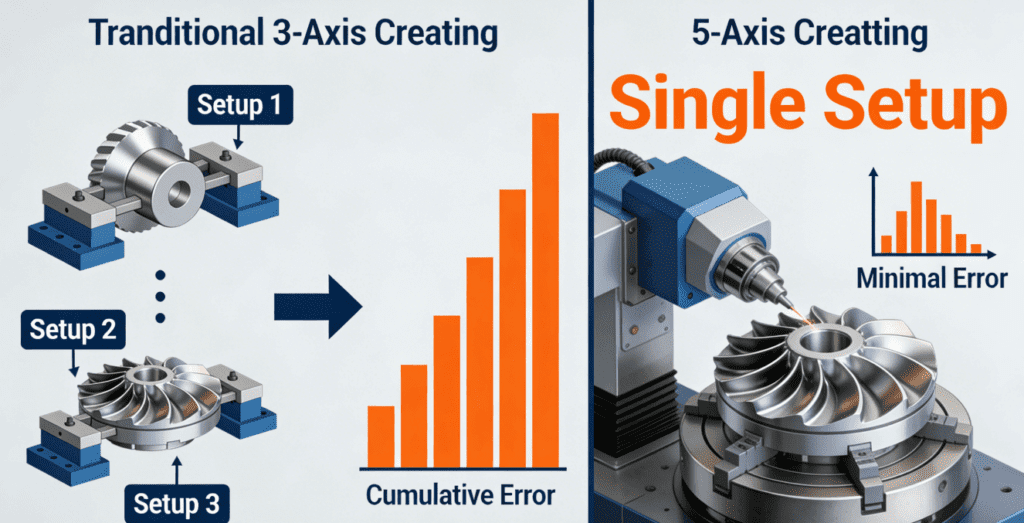
5-axis CNC machining is the epitome of subtractive manufacturing technology, defined by the ability of a machine tool to move a cutting tool or workpiece in five different axes simultaneously. In addition to the three linear axes (X, Y, Z), it involves two rotational axes (usually A and C), allowing the cutting tool to move towards the workpiece from any direction in one single setup. This multi-axis functionality is a paradigm shift from the restricted approach directions of 3-axis machines.
The Fundamental Leap in Accuracy
The most fundamental benefit of this technology is its revolutionary effect on Precision Manufacturing. Performing most machining tasks in one single clamping eliminates the cumulative datum errors, which are common in processes that require multiple re-fixturing.
- Quantifiable Precision and Real-World Application
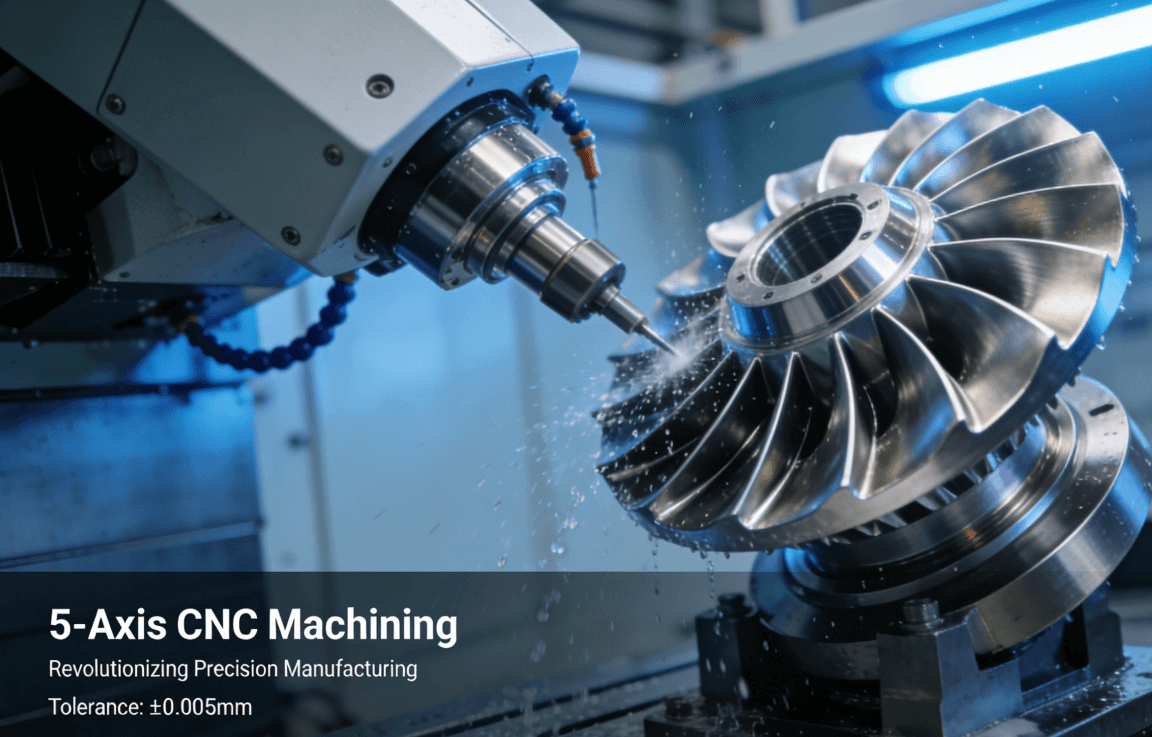
The Modern CNC Technology ensures that the latest 5-axis machining centers are able to hold tolerances as precise as ±0.005mm, and even greater precision can be achieved in the most sophisticated systems. This precision cannot be compromised in the aerospace industry, where the performance of a turbine blade depends upon perfect conformance to specifications, and in the medical industry, where surgical implants require perfect fit.
- The Framework of Quality: Adherence to Standards
To attain this level of precision, there are a series of quality management systems that are in place, and international standards like the ISO 9001 are crucial in providing a framework that ensures consistency, traceability, and improvement. Reputed 5 Axis CNC Machining Services Providers are able to provide these services as part of their core business.
Expanding the Envelope of Manufacturable Geometries
In addition to precision, 5-axis machining also helps in expanding the possibilities of manufacturability, and there are many parts that cannot be manufactured in a single piece, like impellers, turbofan blades, and prosthetic joints, which can now be manufactured with relative ease.
What Are the Core Advantages of 5-Axis CNC Compared to Traditional Machining Methods?
The shift to 5-axis CNC technology results in numerous dimensions of benefits, particularly in terms of efficiency. For instance, efficiency is greatly improved, particularly when using a single clamping operation, which can reduce non-cut time by 50% or more. Such efficiency is particularly beneficial for Rapid Prototyping, where design iteration is critical. It can reduce development time from five days to just two.
Moreover, no other technology can compete with 5-axis CNC technology, particularly in terms of capability, where simultaneous movement in multiple axes can produce complex, organic shapes that cannot be produced using 3-axis machines. Such capability can benefit various industries, from advanced Industrial Equipment to medical devices that must perfectly fit the body. It can also reduce material wastage, which is beneficial from a cost and green perspective. Companies that can provide high-quality 5 axis milling services can provide a new benchmark in manufacturing efficiency, speed, and quality.
How Does 5-Axis CNC Technology Achieve Cost Efficiency and Sustainable Manufacturing?
Even though 5-axis CNC technology requires a greater investment, it can provide greater economic and environmental benefits, particularly as a foundation for cost-efficient and sustainable manufacturing.
Deconstructing the Direct Cost-Saving Mechanisms
Single-setup machining eliminates the requirement for multiple dedicated fixtures, minimizes the requirement for manual labor, and minimizes machine occupancy time per part. Thorough analysis confirms that the use of the technology will lead to reduced direct labor and production costs by as much as 30%.
Empowering the Renewable Energy and Sustainable Manufacturing Wave
The technology fits perfectly within the context of the global Renewable Energy Manufacturing movement. Complex, large-scale parts such as wind turbines or the brackets required for solar tracking systems require the use of 5-axis machining technology to machine the complex curves and contours. The U.S. Department of Energy’s Advanced Manufacturing Office, among other government agencies, actively promotes the use of such technologies to improve the energy efficiency of the manufacturing supply chain.
- Proactive Environmental Management in Practice
At the forefront of the best 5 axis CNC service providers are companies that incorporate Environmental Management Systems such as ISO 14001. The benefits include optimizing cutting tool parameters to minimize energy consumption, coolant recycling, as well as minimizing waste through the use of tool paths. The benefits are the creation of high-quality Custom Parts with the least negative impacts on the environment.
- The Strategic Long-Term Value Proposition
The value proposition goes beyond simply per, part cost calculations and includes faster time, to, market, lower scrap rates, and no rework, thus 5, axis CNC becomes a strategic asset to the company, not just a manufacturing tool.
The Synergy Between Cost Efficiency and Sustainability
Cost efficiency and sustainable manufacturing demonstrate increasing synergy, as process optimizations that save time and money simultaneously reduce environmental footprint through decreased material waste and energy consumption.
What Challenges Does 5-Axis CNC Face in Complex Part Machining and How Are They Solved?
The deployment of complicated components complex parts 5-axis machining inevitably raises issues in the main areas of programming complexity and process control. The risk of tool interference or collision is higher as the rotating axes move continuously, which is sorted out through high, end CAM software with built, in collision detection and full machine simulation. Such virtual environments allow offline checking before the actual machining.
The problem of tool access in deep cavities or around complex features can lead to bending, bad surface finish, or the tool wearing out very quickly. Advanced CAM techniques such as using the tool tangentially for pencil milling or trochoidal milling paths keep chip load and engagement angle constant. Machining thin, walled structures or high, strength materials can lead to vibrations or heat deformation, which can be resolved by implementing dynamic fixtures, cutting parameters optimization, and multi, stage roughing, as well as finishing strategies. Skilled 5 axis machining service providers develop procedures to guarantee trustworthy results even when faced with these issues.
What Are the Future Trends for 5-Axis CNC Technology in Manufacturing?
The future of 5, axis CNC Technology is expected to be smarter, more connected, and more user, friendly. The Industrial Internet of Things (IIoT) will be so deeply integrated that machines will become highly communicative data points capable of monitoring their own health, tool wear, and performance in real, time, thus facilitating predictive maintenance and adaptive machining.
The combination of additive and subtractive manufacturing within single 5, axis platforms is a great way to fabricate complex, near, net, shape structures by means of 3D printing followed by high-precision finishing. In Rapid Prototyping and custom manufacturing, AI, powered CAM software will be able to generate efficient, collision, free tool paths automatically, cutting down on programming time and lowering the level of expertise required. These developments will open up 5, axis machining to a wider audience, thereby firmly establishing it as the core of advanced Industrial Equipment innovation, especially in high, growth sectors like Renewable Energy Manufacturing.
Conclusion
By single, setup machining error accumulation is eliminated and the door is opened to new geometric complexity possibilities. The resulting speed and cost, effectiveness gains, along with the benefits of sustainable manufacturing, make it essential to stay ahead of the competition. JS Precision is one of the companies that have developed expertise in mastering these advanced capabilities. Engineers and product developers working with the most challenging project requirements should consider how this radical technology can help them optimize their projects.
Author Biography
This article was composed by a seasoned manufacturing specialist with over a decade of experience in precision machining, focusing on CNC technology innovation and application within high-end manufacturing sectors.
FAQ Section
Q: What is the minimum tolerance that can be achieved with 5-axis CNC machining?
A: The best tolerance that can be achieved with 5-axis CNC machining is ±0.005mm, which is required for applications in the aerospace industry with stringent requirements.
Q: Is 5-axis CNC machining appropriate for low-volume production?
A: Yes, the flexibility of 5-axis CNC machining allows for economic production of low-volume parts with quick change tooling systems that have low setup times.
Q: How do you select a 5-axis CNC machining service?
A: The selection of the 5-axis CNC machining service is determined by the relevant certification (AS9100D), the level of precision of the equipment, and the experience of the service with similar parts.
Q: What materials are used in 5-axis CNC machining?
A: Materials used in 5-axis CNC machining include titanium, aluminum, stainless steel, and other plastics, including PEEK, depending on the required properties of the materials.
Q: Can 5-axis CNC machining be used for parts of renewable energy equipment?
A: Absolutely, 5-axis CNC machining is very appropriate for the production of wind turbine blades, considering the simultaneous motion required for the production.