Contents
- 1 Introduction
- 2 What Are the Top Challenges in Modern Aerospace CNC Machining?
- 3 How Can Advanced Thermal Management Techniques Prevent Titanium Alloy Distortion?
- 4 What Role Do Certifications Like AS9100D Play in Ensuring Aerospace Quality?
- 5 How Does Real-Time Monitoring Enable Micron-Level Accuracy in Aerospace Parts?
- 6 Why Is Specialized Tooling Design Critical for Aerospace Thin-Wall Structures?
- 7 How Can Digital Twins and Rapid Response Systems Cut Aerospace Project Lead Times by 40%?
- 8 Conclusion
- 9 FAQs
Introduction
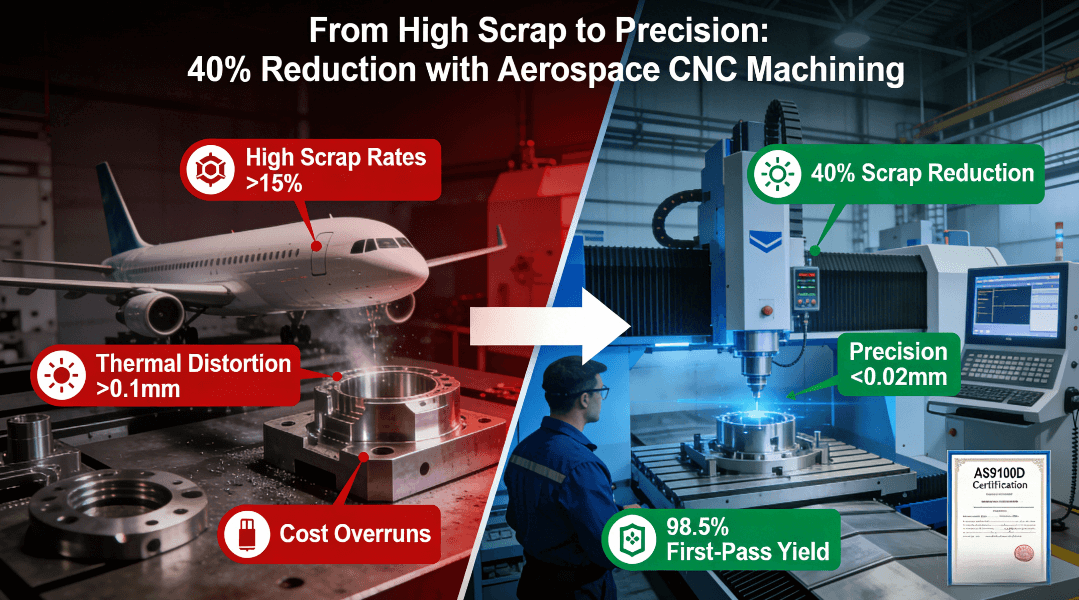
In the field of aerospace manufacturing, the problem of excessive scrap, which is above 15%, is a common phenomenon, especially when it comes to the production of critical components such as titanium alloy components, where deformations are above 0.1mm. In the case of CNC machining, it is hard to achieve the required precision, especially when dealing with the production of critical components that are required in the aerospace environment, such as Inconel components.The causes of the problem include inadequate thermal management, the absence of real-time monitoring, and the fact that the processes are outdated and not suitable for the production of the required components.
The article will discuss the data-driven precision machining strategy that is capable of increasing the first-pass yield to 98.5%. The article will also discuss the various approaches that are capable of ensuring that the required results are obtained.
What Are the Top Challenges in Modern Aerospace CNC Machining?
Aerospace industry CNC machining services face various challenges, which are discussed in the following section.
1. Thermal Distortion in Titanium Alloys
Titanium alloys are commonly used in aerospace industry products, which are often susceptible to warping during machining, resulting in a distortion of up to ±0.1mm due to heat, which directly impacts aerodynamic performance. Engine mounts, for example, require a tolerance of up to ±0.025mm, but conventional cooling systems are ineffective in managing temperature, resulting in a 20% increase in scrap rate. Referring to the ASME Y14.5 standard shows that geometric tolerancing is vital in maintaining part integrity under conditions of thermal stress.
2. Precision Requirements for Composite Materials
One of the main precision requirements for composite materials, like carbon fiber reinforced polymers, is the tolerance of 0.025mm for holes drilled in composites that are susceptible to delamination. On the other hand, conventional machining methods for drilling holes in composite materials may cause fraying and misplacement, and hence, the rejection rate can be 25% or more. Specialists machining procedures can not only achieve high precision but also ensure longer tool life.
3. Low Yield Rates with Superalloys
Superalloys such as Inconel are characterized by work hardening as well as toughness. This leads to tool failures as well as surface defects. When it comes to the manufacturing of turbine blades, for example, up to 30% scrap rates are experienced due to the presence of micro-cracks as well as dimensional issues. Optimized cutting parameters are essential in the mitigation of such problems, as has been observed in projects where the yield has been enhanced by 35% using data-driven parameters. To obtain the best support, aerospace CNC machining services are available for the resolution of such issues.
How Can Advanced Thermal Management Techniques Prevent Titanium Alloy Distortion?
First of all, the implementation of advanced thermal management techniques plays a key role in the removal of heat, related defects.
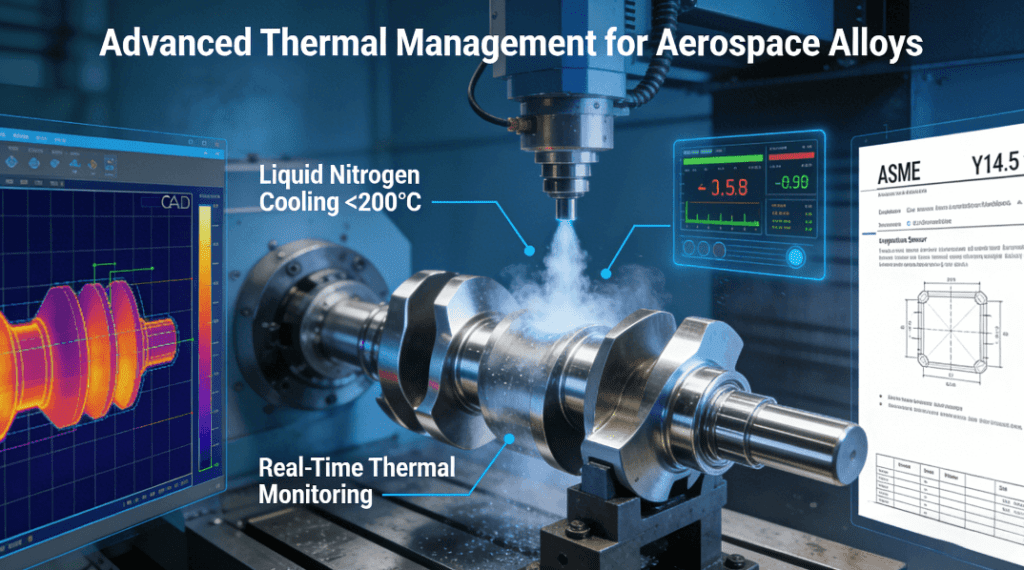
- Liquid Nitrogen Cooling Systems: By using liquid nitrogen for cryogenic cooling, temperatures in the machining zone are kept below 200C, thereby reducing thermal expansion by up to 60%. A cooling system in a case study of aircraft landing gear parts made sure that the deformation stayed below 0.05mm, which was in line with ASME Y14.5 tolerance standards. The instantaneous heat removal capability prevents microstructural changes, and thus, the life of the parts is extended. This technique is a must in aerospace machining.
- Adaptive Toolpath Strategies: Adaptive toolpath strategies refer to utilization of continuously changing toolpaths that modulate their speed and increment of cut based on communication with in, process thermal sensors and thus achieving even heat distribution. A case in point is aircraft fuselage frames machining, in which the use of the technique helped to cut down peaks temperatures by nearly 40%, hence avoiding warping. By leveraging simulation software, manufacturers are able to foresee the heat zones and thus be able to decrease the scrap rate by 25%.
- Case Example: Engine Mount Success: The project case study of the titanium engine mounts manufacturing was the key factor of achieving a very high first pass yield of 98% due to the use of high, pressure coolant jets and temperature monitoring. The measured deformations turned out to be within the limits of 0.02mm effectively surpassing the industry standards. This instance perfectly signifies the significant role of the integrated cooling systems.
What Role Do Certifications Like AS9100D Play in Ensuring Aerospace Quality?
The role of the certifications in the quality assurance of the aerospace industry can be gauged from the fact that it is a non-negotiable requirement.
1. Process Standardization and Control
The AS9100D certification for quality management systems in the aerospace industry ensures the implementation of documented procedures for each operation in the production process. This results in the elimination of variables, thereby reducing error rates by a staggering 30%. For example, a supplier achieved a reduction of 45% in deviations in the machining of wing spars.
2. Full Traceability for Accountability
A digital traceability system can identify production components, monitor processes, and track product checkouts. If there is a problem, it can be easily identified and corrected. A case was reported wherein a solution was figured out within a few hours instead of days, all credit to the traceability system. This information is crucial to eliminating product recalls and meeting international regulations.
3. Leveraging Multi-Certification Advantages
When a company obtains quality and sustainability certifications (such as ISO 9001 and ISO 14001), it essentially demonstrates its commitment to achieving overall operational excellence. A company’s ISO 9001 and ISO 14001 certifications ensure that projects will be conducted in an environmentally friendly and precise manner, aligning with the global trend of green manufacturing.
How Does Real-Time Monitoring Enable Micron-Level Accuracy in Aerospace Parts?
Real-time monitoring technology relies on sensors and analytics to keep tolerances within microns, revolutionizing precision technology.
1. Path Corrections via Sensor Data
Process probes and laser scanners can measure changes as small as 0.005mm. Thus, the system can make the path correction of the tool automatically. In the case of thin, walled parts, the machine was able to keep the deformation under 0.02mm, and consequently, the production yield was doubled by 40%.
2. Integration with Statistical Process Control (SPC) Analysis Tools
SPC analysis software monitors essential parameters such as surface finish and diameter, alerting operators to potential problems before they generate rejects. In a satellite part production project, SPC analysis reduced scrap from 12% to 3% by allowing for predictive action. This data-driven strategy is essential for mass production.
3. Rapid Quoting and Project Launching
Automated quoting software relies on past performance data to deliver precise quotes in minutes, simplifying project startup. For custom requirements, our instant quoting CNC machining service can quickly provide customized CNC machined parts.
Why Is Specialized Tooling Design Critical for Aerospace Thin-Wall Structures?
Specialized tooling design helps meet the needs of thin-wall structures, as they are often subject to vibrations and distortions during processing.
- Vibration Damping and Stability: Using modular fixture systems, vibrations are damped using materials that ensure stability with repeatability within ±0.005mm. Specialized jigs were used to process an engine housing with a weight of 85kg. The tooling ensured that chatter marks were reduced, allowing for a surface finish with an Ra value of 0.4μm. This level of precision is critical for aero-structural integrity.
- Adaptive Clamping Techniques: Hydraulic clamping is important because it prevents distortions in critical features due to tooling pressure. This was seen in a situation where the tooling was used to complete an order that required the creation of airflow ducts. The tooling was used to ensure that warping was not experienced and that all dimensions were within 0.01mm of the required specification.
- Case Study: Innovation at a Company: A company developed tooling technology for military drones that enabled them to achieve 99% accuracy when machining wall panels with a thickness of 0.5 mm. They accomplished this by using carbon fiber composite fixtures, which helped reduce weight and improve accessibility, thereby shortening the machining cycle by 20%. This case study highlights the importance of customized tooling in improving the efficiency of aerospace component manufacturing.
How Can Digital Twins and Rapid Response Systems Cut Aerospace Project Lead Times by 40%?
Digital twins help in simulating production processes, whereas rapid response teams help in dealing with problems before they occur, thus reducing timelines.
1. Digital Twin Optimization
Virtual replicas of production processes can help simulate parameters and reduce time and cost associated with a project. For a rocket nozzle project, digital twin optimization resulted in a 50% reduction in setup time and eliminated the need for trial runs. The accuracy of the simulation can help ensure timely execution of the project.
2. Concurrent Engineering and Stock Management
The rapid response teams operate in parallel with the design teams, allowing them to resolve issues in real time. In conjunction with the strategic material inventory, this has reduced lead times from 4 weeks to 10 days for emergency orders. This collaborative structure enables the accelerated time-to-market while ensuring quality.
3. Financial and Operational Benefits
Manufacturers can save up to 25% in holding costs due to reduced delays. In one case, a commercial aircraft program saw a 40% reduction in overall duration, demonstrating the value of digital integration. When it comes to support, there are various options available, such as aerospace component manufacturing.
Conclusion
The precision CNC machining, combined with the strategies of thermal management, real-time monitoring, and certified systems, is a powerful solution to the challenges that are inherent in the world of aerospace manufacturing. This is because it is not only possible to reduce scrap rates by 40%, but it is also possible to achieve growth through the data-driven strategy that is required to succeed in this environment.
FAQs
Q1: What is the lead time for aerospace CNC machining projects?
A: For prototype production, the lead time is 10-15 days. For batch production, it takes 20-25 days. With rapid response services, this can be reduced by 40%.
Q2: How does the company provide material traceability services for aerospace components?
A: With full digital traceability, material certificates are linked to final inspection. This ensures accountability from the raw material stage to the final part, meeting AS9100D requirements. A unique ID is assigned to each part.
Q3: Can CNC machining handle complex materials like Inconel for aerospace parts?
A: Yes. By using ceramic tooling together with high, pressure coolant, Inconel can be machined. This helps in controlling work, hardening and gives a finish that meets the aerospace standards.
Q4: What are the important certifications that are required in aerospace industry CNC machining?
A: The key certifications for aerospace industry CNC machining include AS9100D for quality, ISO 9001 for process, and ISO 14001 for sustainability.
Q5: What is the process for getting a quote in real-time for custom parts?
A: Online systems use historical data analysis for part geometry and material considerations, providing an accurate quote in minutes, which helps in speeding up the project initiation process with an accuracy of ≥95%.
Author Bio
The writer of this article is a precision manufacturing specialist at LS Manufacturing, a company that assists aerospace engineers in overcoming complex part challenges. They have AS9100D and ISO 9001 certifications and offer quality solutions. For more information on these methods for your aerospace project, request a custom solution quote or contact them for a free DFM analysis.