Nonchalant Meaning: Definition, Examples, and Everyday Usage
Introduction
You may have heard someone described as nonchalant in a movie, on social media, or during a casual conversation. Sometimes the word is used as a compliment, while other times it suggests that someone doesn’t seem to care. But what does nonchalant actually mean?
Understanding the meaning of nonchalant can help you use the word correctly in both speaking and writing. It is a common English adjective that describes a calm, relaxed attitude, especially in situations where others might expect excitement, worry, or concern.
In this guide, you’ll learn the definition of nonchalant, its pronunciation, origin, synonyms, antonyms, and plenty of real-life examples to help you understand the word naturally.
What Does Nonchalant Mean?
Nonchalant is an adjective that describes someone who appears calm, relaxed, and unconcerned, even in situations that might normally make people nervous, excited, or emotional.
Simple Definition
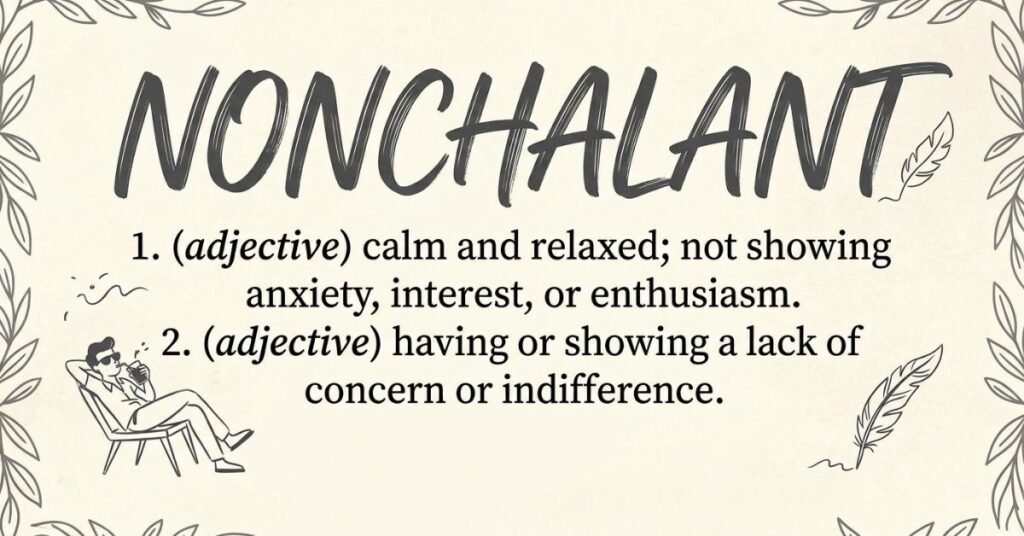
A nonchalant person behaves as though nothing is bothering them. They remain cool, composed, and unaffected by what is happening around them.
Dictionary-style definition:
Nonchalant (adjective): Feeling or appearing casually calm and unconcerned.
The word usually refers to someone’s attitude rather than their personality. A person may act nonchalant in one situation but become emotional in another.
Pronunciation of Nonchalant
The word is commonly pronounced as:
non-shuh-LAHNT
You may also see it written phonetically as:
/ˌnɒnʃəˈlɑːnt/
The stress falls on the final syllable.
Origin of the Word Nonchalant
The word nonchalant comes from the French word nonchaloir, which means “to disregard” or “to be unconcerned.”
It entered the English language during the 18th century and has continued to describe people who remain calm or indifferent in various situations.
Although its origin suggests a lack of concern, modern English often uses the word to describe a relaxed or composed attitude rather than complete indifference.
What Does Being Nonchalant Look Like?
Being nonchalant doesn’t always mean someone doesn’t care. Instead, it often means they choose not to show strong emotions.
For example:
- Someone receives unexpected praise but simply smiles and says, “Thanks.”
- A student remains calm before an important exam while classmates are nervous.
- An athlete confidently walks onto the field without appearing anxious.
- A person shrugs after a small mistake instead of overreacting.
In each case, the person appears calm and collected.
Examples of Nonchalant in Everyday Life
Understanding a word becomes easier when you see it used in real situations.
At School
A student walks into the classroom moments before the test begins. Everyone else is reviewing notes, but the student quietly takes a seat without looking worried.
Example sentence:
She remained nonchalant before the final exam.
At Work
An employee handles an unexpected problem without showing stress.
Example sentence:
He gave a nonchalant response even though the deadline had changed.
During Sports
An experienced player scores the winning point but celebrates with only a smile.
Example sentence:
The captain looked completely nonchalant after the victory.
In Daily Conversations
Someone spills coffee on their shirt but laughs it off instead of becoming upset.
Example sentence:
She acted surprisingly nonchalant about the accident.
Example Sentences Using Nonchalant
Here are more examples that show how the word fits into different situations.
- He gave a nonchalant shrug and continued walking.
- She answered the difficult question with a nonchalant smile.
- Despite the unexpected news, he remained nonchalant.
- His nonchalant attitude impressed everyone.
- She appeared nonchalant during the interview.
- The traveler stayed nonchalant despite the flight delay.
- He spoke in a calm, nonchalant voice.
- Her nonchalant reaction surprised her friends.
- The manager remained nonchalant throughout the meeting.
- They walked away with a nonchalant confidence.
Synonyms of Nonchalant
Several English words have meanings similar to nonchalant. The best synonym depends on the context.
| Synonym | Meaning |
|---|---|
| Calm | Free from stress or excitement |
| Relaxed | Comfortable and at ease |
| Composed | Emotionally controlled |
| Unconcerned | Not worried |
| Casual | Informal and easygoing |
| Cool | Calm under pressure |
| Collected | Self-controlled |
| Easygoing | Relaxed by nature |
| Unruffled | Not disturbed |
| Laid-back | Calm and relaxed |
Antonyms of Nonchalant
These words express the opposite meaning.
| Antonym | Meaning |
|---|---|
| Nervous | Feeling anxious |
| Worried | Concerned about something |
| Excited | Showing strong emotion |
| Anxious | Uneasy or tense |
| Emotional | Expressing strong feelings |
| Concerned | Caring deeply about something |
| Agitated | Disturbed or upset |
| Panicked | Extremely frightened |
| Stressed | Feeling pressure |
| Restless | Unable to relax |
Is Being Nonchalant Good or Bad?
The answer depends on the situation.
Sometimes being nonchalant is considered a positive quality because it shows confidence, emotional control, and the ability to stay calm under pressure.
For example:
- Staying calm during a job interview
- Remaining confident before giving a presentation
- Handling unexpected challenges without panic
However, being too nonchalant can sometimes create the impression that someone doesn’t care about important matters.
For example:
- Ignoring responsibilities
- Showing little concern when others need support
- Acting indifferent during serious conversations
The key is balance. Remaining calm is often admired, but appearing completely uninterested may lead to misunderstandings.
Nonchalant vs. Indifferent
Although these words seem similar, they are not exactly the same.
Nonchalant usually refers to someone’s outward behavior. A nonchalant person may actually care but chooses not to show strong emotions.
Indifferent means someone genuinely has little or no interest or concern about something.
Example
A basketball player wins an important game and simply smiles.
This player is nonchalant because they remain calm.
If the player truly didn’t care whether they won or lost, they would be indifferent.
Nonchalant vs. Confident
People sometimes confuse these two words.
A confident person believes in their abilities.
A nonchalant person appears calm and unconcerned.
The two qualities can exist together, but they describe different things.
For example:
A speaker may be confident because they know the topic well, while also appearing nonchalant because they stay relaxed throughout the presentation.
How to Use Nonchalant Correctly
The word is commonly placed before a noun or after linking verbs.
Before a noun
- A nonchalant attitude
- A nonchalant smile
- A nonchalant response
- A nonchalant expression
After a verb
- She seemed nonchalant.
- He remained nonchalant.
- They looked nonchalant.
- The actor appeared nonchalant.
Common Mistakes When Using Nonchalant
Many English learners make small mistakes with this word.
One common mistake is assuming nonchalant always means lazy. In reality, it describes someone’s calm attitude rather than their willingness to work.
Another mistake is using it for objects. Nonchalant is generally used to describe people, expressions, attitudes, or behavior—not things like cars, buildings, or weather.
It’s also important not to confuse nonchalant with careless. A person can be very responsible while still appearing calm and composed.
Why Is the Word So Popular Today?
The word nonchalant has become especially popular on social media platforms like TikTok, Instagram, and X. People often use it to describe someone who stays cool, avoids overreacting, or maintains a relaxed vibe in everyday situations.
In online conversations, “being nonchalant” is sometimes associated with confidence or emotional self-control. However, it’s worth remembering that internet slang can simplify or exaggerate meanings. In standard English, nonchalant simply refers to appearing calm and unconcerned.
Tips for Remembering the Meaning
A simple way to remember the word is to think of someone who stays calm while everyone else is reacting emotionally.
You can also associate nonchalant with these ideas:
- Calm under pressure
- Relaxed attitude
- Cool behavior
- Not easily disturbed
- Showing little outward emotion
The more you encounter the word in books, articles, and conversations, the more natural its meaning will become.
Frequently Asked Questions
Is nonchalant a positive word?
It can be. It often describes someone who remains calm and composed, but in some situations it may suggest that a person seems too unconcerned or emotionally distant.
Can a person be nonchalant and still care?
Yes. Someone may care deeply about a situation while choosing not to show strong emotions.
Is nonchalant the same as confident?
No. Confidence is about believing in your abilities, while nonchalant describes a calm and relaxed outward attitude.
Can nonchalant describe emotions?
Not directly. It usually describes a person’s behavior, expression, attitude, or manner rather than the emotion itself.
Is nonchalant commonly used in English?
Yes. It is a widely recognized word in both written and spoken English and appears frequently in books, news articles, and everyday conversations.
Final Thoughts
The word nonchalant describes someone who appears calm, relaxed, and unconcerned, especially in situations where others might expect a stronger emotional reaction. While it can suggest confidence and composure, its meaning depends on the context. In some cases, a nonchalant attitude is admired for showing emotional control, while in others it may come across as detached or uninterested.
Learning how to use nonchalant correctly can improve your vocabulary and help you express subtle differences in behavior and attitude. Whether you’re reading novels, watching movies, or engaging in everyday conversations, you’ll now be able to recognize and use this versatile word with confidence.

Ellie Wheatley is a dedicated writer at AVTube.org who enjoys creating accurate, engaging, and easy-to-understand content. She is passionate about sharing helpful information, researching reliable sources, and delivering high-quality articles that keep readers informed and inspired.